Space Opera · Chapter 2
The Narrowing Dark
Captain Rix, Driftrunner
Rix went to the Soren Narrows to capture a signals relay. He came back with a command node, a mole on his own flagship, and proof that the enemy he thought he was fighting answered to something older than the Accord itself. Every success tightened the noose.
Part One — Operation Narrow Gate
The ARS Resolute smelled like reheated coffee and patient desperation. Twelve ships in the Vallant Reach system, and Admiral Kessrin ran them all from a wardroom where the charts on the walls were a generation out of date. Rix noticed. Kessrin noticed him noticing.
Torr disappeared into Bay Seven before the Meridian's engines had finished cycling down. Chief Engineer Patel ran a hangar the way some people run a religion — by quiet hierarchy and favors — and the Meridian had jumped her queue on the strength of a single bottle of Kaelish Gold. One delivered. One still owed. Patel kept a tally the way most people kept a conscience.
There were people on this ship. Doss in the armory, who treated requisitions like confessions. Lieutenant Arak in intelligence, still young enough to care out loud. Captain Dray of the Ironclad, whose trust was a fortress with no visible door, because he'd buried sixty crew at Kerreth Veil six months ago and was not yet done counting them.
Rix went to see Laine first.
She was in the observation lounge, watching the stars like they owed her something. Custody had not been unkind to her. She was eating, sleeping, going through the motions of being a person who had chosen to be saved. But the Helix jacket was still folded at the foot of her bed, because she hadn't decided yet which part of herself she was keeping.
She mentioned a name. Oshi's kid. On Verath Station.
She did not ask him for anything. She just set the name down between them like a stone, and watched to see if he would pick it up or step around it.
Rix picked it up.
Kessrin's briefing room the next morning was a map of the Soren Narrows and a problem shaped like Rix's competence. Capture a Helix signals relay. Standard intelligence work. The kind of mission whose difficulty only becomes legible once you are inside it.
He pitched for resources and talked well, but not well enough. Kessrin gave him two-thirds of what he asked for and a warning disguised as a compliment. He pitched Laine for the operation and landed that one clean, because Kessrin respected a captain who spent his political capital on his people. Then Arak laid out the raw intelligence, and Rix did what Driftrunners do to a chart: he looked for the seams nobody had meant to leave.
Three tactical advantages fell out of the data like coins from a torn pocket. Approach routes, sensor shadows, the specific and exploitable laziness of a rotation schedule written by a man who had never been caught. Rix read it twice to be sure and then once more because he did not believe in luck.
The Narrows run went the way a good plan goes when the universe briefly cooperates. Gutter transit, shadow approach, cloaked docking. Simultaneous breach, because Laine through the front hatch in Helix colors bought them the half-second of confusion that meant nobody died. And then, inside: the relay was not a relay. It was a command node. Six months of operational orders in a server rack on a station that thought it was nothing.
They pulled ninety-seven percent of it. Encryption keys. Routing. Every thread Helix had run through this sector since the spring.
Sable planted a leech on the antenna as they left. The station woke up that night not knowing it had been read cover to cover.
The debrief was where the ground shifted.
Three compromised Assembly delegates, named. Fourteen safe houses. Seven supply caches. Three covert weapons labs. And a name at the top of it that had been a ghost until that morning: Director Sera Vos. Helix's sector commander. Based at a facility in the deep Rim called Pinnacle.
Rix listened and made a recommendation that surprised him as much as anyone: delay the vote. Not because he wasn't sure — because he was. The Assembly was a lever. Pinnacle was a foundation. If you hit the foundation first, the lever would still be there when you needed it.
Kessrin listened. Kessrin agreed. Kessrin then did a thing he had not been braced for, because he had spent his life being a man who other people paid for jobs and then forgot. She promoted him. Captain, provisional. She designated his crew Special Operations Unit Meridian, said it in a tone that made it real, and waited for him to understand what she had just put on his shoulders.
Dray didn't congratulate him. But later, in the mess, he set a bottle of Kerreth whiskey on the table between them and said I was wrong about you, in the particular way of a man for whom being wrong about a person was a structural event. They drank. Dray told him about the two ships and sixty crew he had lost at the Veil. Rix understood that the bottle was not an apology. It was a record.
Part Two — The Shadow Campaign
Sable found the crack first, the way Sable found everything: by refusing to stop looking at something after the rest of the room had moved on.
Pinnacle's nav-beacon cipher rotated every seventy-two hours. Sable had eighty-three rotation outputs in sequence. Enough to see a pattern, enough to predict the next three with confidence that decayed clean: eighty-seven, seventy-nine, sixty-eight. Nine days of window, narrowing.
The waystation leech on the captured relay started paying out within hours. Helix knew someone had hit them but did not know who. Sector-wide asset recall. Forty-eight-hour rekey. And inside the chatter, one word that made Arak go still in the way only intelligence officers go still: Solitaire. An asset operating inside Vallant Reach. Receiving orders direct from Pinnacle.
There was a mole on the Resolute.
Rix went back to Kessrin that afternoon and asked for the Verath Station search. Oshi's kid. He made the case the way Laine had handed him the name — carefully, without demand, as a thing a person could pick up or set down. Kessrin set it down.
Not yet, she said. After Pinnacle. You have my word.
It was a fair answer and a correct one and he hated it. He went to find Laine and told her in person, because the thing he had promised himself about Laine was that she would never hear anything about Laine from anyone but him.
He told her badly.
The framing was wrong. He led with the operational logic and trailed the personal, and he watched her face close between one sentence and the next. Not anger. Laine did not do anger. Something worse: the careful, controlled professionalism of a person who has just decided to stop expecting anything from you.
Cohesion cracked. Not broken. Cracked.
He went back at midnight because the thing he could not do was let her sleep on it.
He did not apologize, because apologies were cheap currency and Laine had spent her whole life being underpaid. He gave her the infiltration planning lead. He named what she had done, specifically — the junction point she'd identified, the waystation comms specs she'd delivered twelve hours after being compartmented, the fact that the plan they were building was her architecture and he intended to say so in every room where it mattered.
She listened with her hands in her lap.
"Rix," she said at the end, and it was the first time she had used his name without a rank attached to it in three days, "you cannot keep doing this to the people who trust you and expect the trust to survive."
"I know," he said.
"Good," she said. "Then don't."
He left. The crack sealed, slowly, the way trust seals when it has decided to give you one more attempt.
The plan grew two tracks and a shadow.
Track One was Pinnacle through the supply chain. A logistics handler codenamed Carren, contracting independent freight crews out of Deval Point, loading them with Pinnacle's resupply and sending them through the waystation into the cluster. Long game, high payoff, the kind of infiltration that required patience Rix did not naturally possess and was learning.
Track Two was the recon. One cold run into the cluster on Sable's first cipher rotation. Map the corvette patrol. Count the turrets. Find whatever was down there to find.
Rix spent a day alone with the cluster charts and found three things nobody had seen, because nobody had looked long enough. A lateral escape route through a low-density pocket that bypassed the beacon entirely. The precise geometry of corvette patrol confinement in the cluster's spoke-channels, which meant the ship could not be everywhere and there were positions in the inner cluster where a cold-running frigate could sit for four hours undetected. And the waystation's blind spot — sensors facing inward, rear aspect dark, approachable from outside the cluster by a ship willing to pretend to be less than it was.
The beacon handshake worked on the first try. Sable's cipher slotted into the lock, the nav-beacon accepted them as friendly, and the Meridian slipped into the cluster like a thief entering a house whose owner had left the door open out of habit.
Four hours at recon position. Passive sensors only. Torr deployed the drone in the first thirty minutes — magnetic clamp to a mid-sized asteroid, antenna angled at Pinnacle, recording everything. They watched the corvette complete a full patrol cycle and mapped its route. They counted the turrets and found two on the ventral surface that were dark. And Sable, running the optical array at the edge of its resolution, picked up a secondary docking port on the far hemisphere — shuttle-sized, recessed, invisible from every angle anyone had thought to check. Not in any of Laine's briefings. Not in any intelligence file. Just there.
Three hours forty minutes in, a courier ship launched from Pinnacle's main hangar. Small, fast, outbound. Rix watched Torr tag it with the EW suite at a range that should have been impossible and had the grace to look surprised at his own result. The courier's drive profile locked into the sensor log like a fingerprint. Heading: Deval Point.
The supply chain was not a theory. The supply chain was a real ship Rix could now identify anywhere in the Rim.
The waystation on the way out was Rix's idea and Sable called it either inspired or suicidal, possibly both.
Pirate act. False transponder, the Meridian broadcasting as a beat-up salvage hauler called Dust Kicker. Sloppy docking at the waystation's inward-facing berth. Breacher charge on the hatch because Rim pirates do not pick locks. Three idiots in a garbage scow demanding mining access codes that did not exist, because the only crime the waystation crew would take seriously was stupidity.
Rix kicked the hatch in with his slug-thrower raised and his Vrynn face doing the thing Vrynn faces did to frightened humans. Sable came in behind him waving a plasma cutter that would have killed them all if she had actually fired it. Thirty seconds of theatrical chaos in the front corridor. The station chief — a hard-eyed woman who had clearly handled worse — had a pistol out and a decision to make, and Rix gave her the easier one by being obviously incompetent.
Torr walked around back.
He opened a service panel that Laine had told him about at six in the morning, reached into a maintenance port that was exactly where her specs said it would be, and seated a leech the size of a coin onto a conduit junction. Ten seconds. Magnetic mount. Drawing power from the cable it was reading.
Rix backed out of the front corridor with his hands visible, swearing loudly about the wrong codes and the wrong rock and the wrong day. The station chief watched him go with contempt, which was the second-best emotion she could have been feeling and vastly preferable to the first. The Meridian undocked sloppily. The waystation filed an incident report: botched robbery attempt, three idiots in a garbage scow, no connection to anything.
The leech began transmitting within the hour.
Back at the Resolute, the pieces moved.
Laine sat down with Commander Renn for a counterintelligence debrief. Cleared in ninety minutes. Renn told Kessrin and Kessrin told Rix, and Rix went and found Laine in the planning room and told her himself, and Laine said good and then kept working, because the debrief had never been the thing that mattered to her. What had mattered was whether he was the kind of captain who would credit her to her face.
Arak's Solitaire hunt narrowed to an ensign named Taro Meck. Shuttle pilot. Three signal matches out of three. Renn set the trap, but did not close it yet, because a mole you control is worth more than a mole you arrest.
Meanwhile Torr rebuilt the Meridian into a ghost. Extreme-range passive tracking. Cold-running drills. A burst-coast protocol — five-second engine burns, forty-minute coasts — that Torr named himself and was quietly proud of. It's the kind of flying, he said, that makes a ship look like a rock with ambitions.
Rix signed the promise to Laine over lunch. Not aloud. He wrote her name on the infiltration plan in three places where it belonged and showed her the draft before it went to Kessrin. Laine read it and nodded once and did not say anything, because there were things that did not need saying when they had been written down correctly.
Then the waystation leech delivered the thing that broke the shape of the chapter.
Director Vos was leaving Pinnacle.
Seventy-two hours. Meeting someone. The message referred to the someone only as the Architect. Destination: deep-space coordinates in the Tessaran Margin, a sector where nothing existed, which was the point.
Rix took it to Kessrin and made the call. Shadow Vos. Delay Pinnacle to the next supply cycle. The Architect was the thread that pulled everything else — a name above Vos meant the network was bigger than they had modeled, and a bigger network meant the Pinnacle infiltration needed to be smarter, not faster. Kessrin agreed on one condition. Observe only. Rix agreed.
Renn calculated the leapfrog. The Meridian departed Vallant Reach six hours before Vos did and arrived at the Tessaran coordinates three hours ahead of her, going cold and dark in the residual radiation of a burned-out dwarf star. Torr killed everything except passive sensors and life support. The ship drifted.
Vos's corvette arrived on schedule.
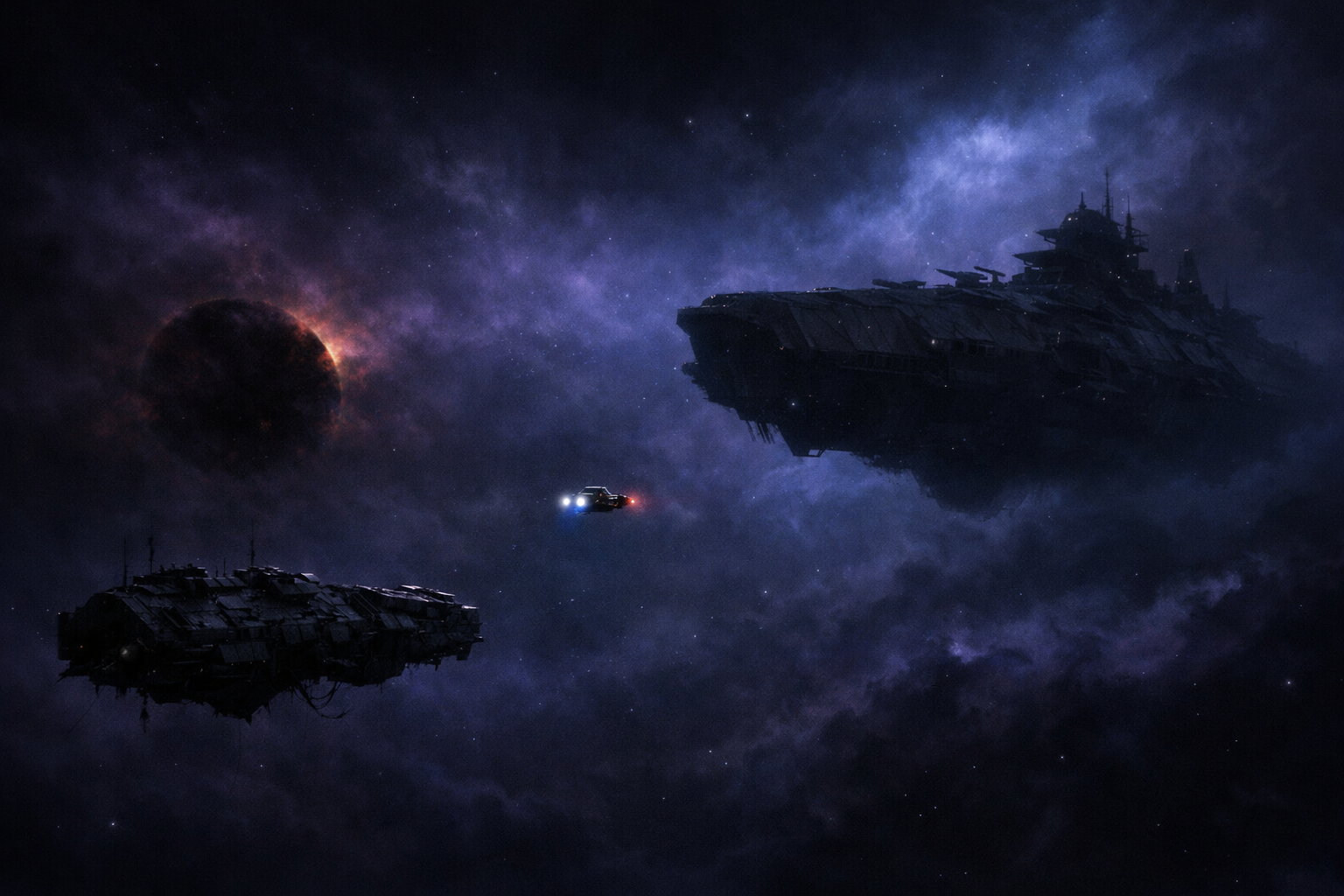
Then, from galactic north, moving at a speed that did not match any drive profile in the Accord database, a heavy cruiser slid out of the dark.
Pre-Fracture Accord naval architecture. Dark-hulled. Unmarked. Military sensor arrays along the dorsal spine. Weapons ports, many of them, sealed but visible. Sable recognized the hull design first and went completely still in her chair.
That ship, she said, was built before the Accord fell.
A shuttle launched from the cruiser and crossed the six kilometers to Vos's corvette. The Architect went to Vos. Not the other way around. That detail meant something and Rix filed it somewhere behind his eyes for later.
He tried to get a visual. Compound eyes that could read a negotiator's micro-expressions across a wardroom table were not enough to resolve a figure through a shuttle viewport at six kilometers. He took the optical data anyway. He would look at it in a year and still see nothing.
The meeting lasted two hours and seventeen minutes. Sable recorded the entire encrypted data exchange. Helix cipher on the outside. Something older underneath — pre-Fracture military encryption, in a language of keys nobody had used since before Rix was born.
Then the cruiser left.
Not jumped. Not accelerated. It activated a signature-masking technology that did not exist in any current database and was gone within four minutes. The kind of stealth that you did not buy on the open market because it had never been on the open market. Departure vector consistent with the Korrath Expanse, or the decommissioned Tessaran Gate, or deep Accord Core space, and every one of those possibilities was worse than the last.
The Meridian sat in the dark with the recording and did not move until the sensors were certain the universe had gone quiet again. Nobody on the bridge spoke. Rix finally said, because someone had to, we need to tell Kessrin before we decide how scared to be.
Solitaire resolved on the way home.
Meck's background told the story the intercepts could not. A younger sister on Verath Station — Aven, nineteen, arrested four months ago on charges that fell apart in forty-eight hours and left a file open in the wrong office. The timing aligned with Meck's first payment. He was not a true believer. He was a brother.
Renn turned him with a protection offer for Aven and a promise the Accord would never take that kind of leverage against a man again while she was running counterintelligence. Solitaire became a doubled agent. The mole became a mirror.
Fourteen days since the Meridian had docked at the Resolute.
The waystation leech confirmed Vos was back at Pinnacle and had issued an all-hands priority order to the garrison within an hour of her return. Something had changed after the Architect meeting. Whatever she had been told, she was acting on it.
The Pinnacle infiltration was in Laine's hands and it was good. Rix and Torr would insert through Carren's next supply crew at Deval Point in eight days. Torr would seat a junction charge in the hangar section. Rix would move solo through the facility to the archives — Vos's personal archives now, priority upgraded by Kessrin from target of opportunity to strategic imperative — and strip whatever was there. Sable would run overwatch from the Meridian outside the cluster. Laine would coordinate from the Resolute with Kessrin and Renn.
Rix sat in the Meridian's cockpit alone that night with the lights off and the star charts reflecting in his compound eyes. He thought about a woman on Verath Station whose kid he had not yet found. He thought about a ghost ship that had been hiding since before the Fracture, meeting in the dark with the commander of everything he was fighting against. He thought about Kessrin promoting him to Captain for an organization that had not existed six months ago and might not exist six months from now.
He thought about Laine saying don't, and meaning it, and deciding to trust him one more time anyway.
Eight days until Carren's crew shipped from Deval Point. Eight days until Rix walked into a fortress run by a woman who answered to something older than the Accord itself.
He ran the numbers one more time. Then he killed the cockpit lights and went to find his crew.
The chapter was over. The next one had already started. He just hadn't told anyone yet.