Noir · Chapter 1
The Margaux Hotel
Hank Garnett, Private Investigator
One of 22 Noir starters. This one dealt Hank a dead client and a woman who might have ordered the hit. Yours will be different. The dice shape everything.
The woman in the doorway didn't look like someone in mourning. She looked like someone running a calculation.
"Find out who did this." Her voice was precise, uninflected. "Before the police decide the simplest answer is standing right here."
She meant him.
Miriam Linde. Dark suit, hair pinned with the kind of severity that passed for elegance in certain circles. She'd hired Finch, and by extension, she'd hired Hank. The engagement, she informed him, was not concluded. Hank tried to get her talking and didn't try hard enough — something in the silence he offered landed wrong, and her chin lifted a fraction. Two words that closed a door. Tomorrow. Eleven o'clock. Bring something the police wouldn't.
She was gone before he could answer. Heels on carpet, then nothing.
Hank crouched behind the chair and read the wounds. Two entries, tight grouping between the shoulder blades. Scorched fabric — close range, not contact. Small caliber, a .32 or a .380, something built for quiet work. Both shots clean. This person didn't panic, didn't need a third round.
The room gave up three things to anyone patient enough to look. No shell casings — policed brass or a catcher. Fresh scratches on the window latch, re-latched from inside, the kind of gouges you get forcing it open and closing it behind you. And the papers on Finch's desk: Castellan Property Group. Account numbers routing through a Cayman prefix. Three words circled in Finch's own handwriting. Shell. Nominee. Offshore.
An accountant who annotates like that is building a leverage file. Or a coffin.
In the service alley, the rain had washed everything soft. Hank quartered the ground the way his sergeant had taught him and the rain won. But under the dumpster's lip, sheltered and dry: a cigarette end. Hand-rolled, filterless. Someone had stood in this alley long enough to finish it. Watching the window. Timing the job.
A door banged open twenty feet away. Night porter. Hank's hand went under the dumpster lip before the man's eyes adjusted — two fingers, pinch, pocket. The porter smoked his own cigarette, stared at the middle distance, and went back inside without ever looking his direction.
Rain hammered the phone booth glass on Calloway Street.
"Navarro."
"Cole. It's Hank."
He kept it casual. Potential job, someone mentioned a name. Castellan Property Group. Ever heard of it?
The silence on Cole's end had texture. Twenty years of homicide work compressed into the particular quality of a man deciding what he couldn't afford to say.
"If someone offered you a job connected to Castellan Property Group, you tell them no." Flat. The way cops say names they've been told not to say. "You tell them you're busy. You tell them your back hurts."
Hank mentioned the Margaux Hotel. Gave him the room number.
"Christ, Hank." Breathing on the line. "Tell me you weren't hired to protect him."
"I can't say anything else. You understand what I mean when I say I can't."
The line went dead. Cole didn't ask him to come in. Didn't threaten him. Just told him to disappear. That wasn't a cop doing his job. That was a friend calculating the cost of knowing Hank Garnett, and Hank stood in the phone booth with the receiver still in his hand and understood that Castellan reached high enough to make a twenty-year sergeant hang up at midnight.
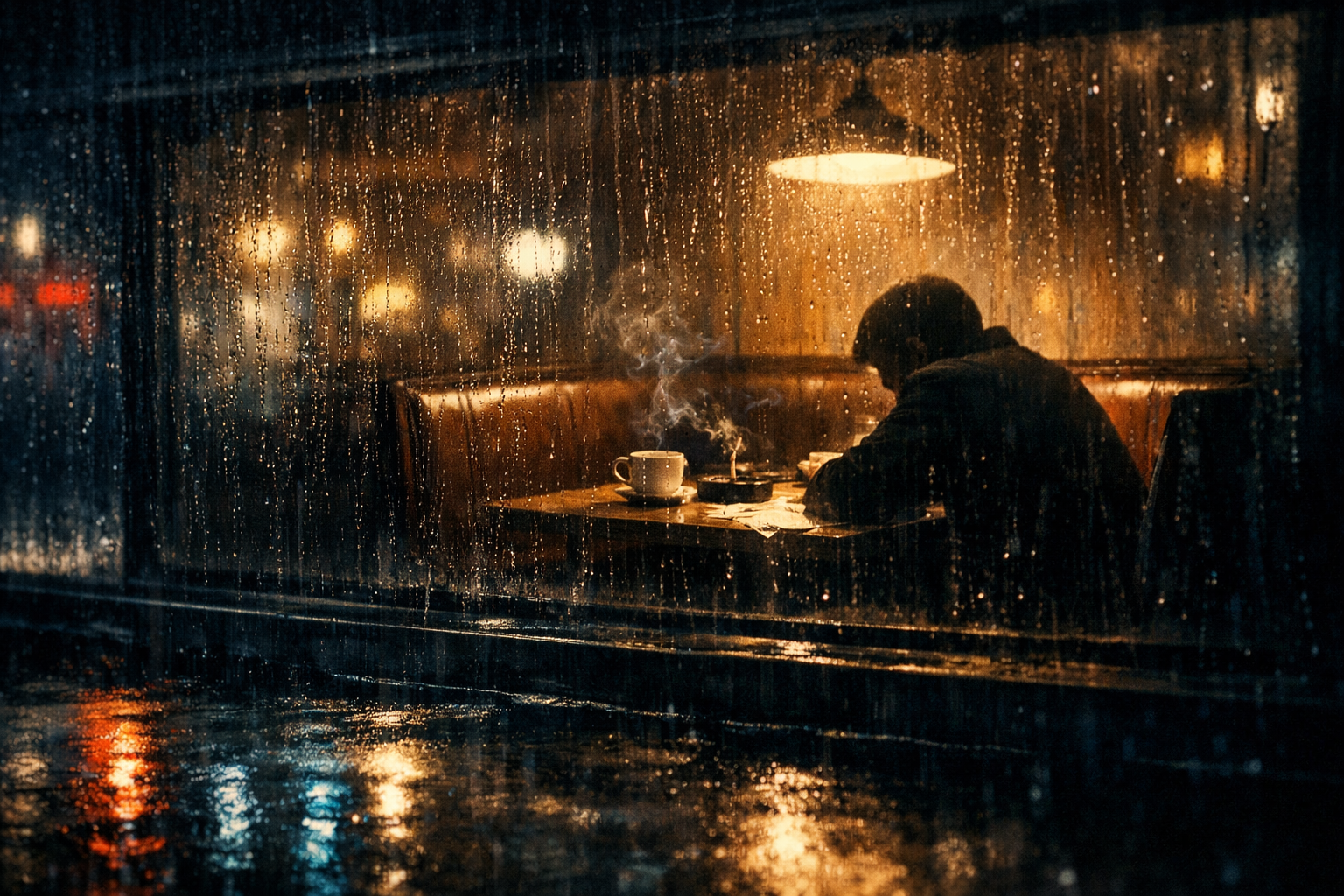
Kelso's Diner. Past one. The coffee had been on the burner since yesterday and the corner booth was the kind of quiet that lets a man think too much.
He laid it out. Professional killing, suppressed weapon, two shots clean. Entry through a third-floor window, re-latched from inside. The cigarette end — a spotter in the alley, which meant a coordinated operation, at least two principals. Castellan Property Group on the desk. Hargrove Holdings. Offshore nominee structures.
He tried to connect the entry angle to the window. It should have fit — the shooter came through high, fired downward into a seated man. Clean geometry. But the desk faced east. The window was on the north wall. Finch would have seen anyone climbing through.
The theory broke in his hands. Two clean shots into a man who saw it coming and didn't move? Either Hank had the orientation wrong, or Finch knew the person who came through that window. Each version was worse than the last.
He stared at the coffee going cold and felt the frustration of a man who'd been sure of something thirty seconds ago. The diner hummed around him. Rain on the windows. A waitress refilling cups she hadn't been asked to refill. And Hank Garnett, ex-soldier, sitting in a booth at one in the morning, trying to hold a picture together that kept shifting every time he thought he had it.
Then he stopped trying to connect the wounds to the window and connected the ledgers to the silence instead.
Finch had Castellan's papers on his desk. Offshore accounts, nominee structures, three words circled in pencil. Cole Navarro heard the name Castellan and shut down — not evasive, institutional. The kind of institutional that means someone with more authority than a twenty-year sergeant will ever have claimed the case and hung a sign on it that said don't touch.
An accountant doesn't circle shell, nominee, offshore unless he's preparing to hand those numbers to someone. A prosecutor. A regulator. Someone with the authority to act on what the numbers mean.
Hank set down the cup. The coffee was cold. The diner was the same diner it had been five minutes ago, but the room felt different now, the way a street feels different when you realize the car parked at the corner has been there too long.
Finch was building a case against Castellan. Annotating ledgers, mapping nominee structures, preparing a file that would make powerful people very uncomfortable. And Castellan found out first.
Not a grudge. Not a robbery. A silencing. The motive was right there in the circled words, and Hank had been staring at entry angles when he should have been reading the desk.
He sat with it. Let the shape of it settle. The waitress dropped the check. Four marks fifty. He left six and didn't wait for change.
Morning. The city registrar confirmed what the diner had given him: Castellan and Hargrove, registered through the same law firm on Velder Street. Different addresses, same nominee signatures. Shells built to obscure the same source.
He ate breakfast at Kelso's without tasting it and walked to Miriam Linde's office at eleven.
She was already there. Dark suit, hands folded on a bare desk, coffee she hadn't touched. He gave her the broad strokes — professional hit, two-person operation, Castellan — and watched her face while he talked.
She didn't flinch at the killing. Didn't flinch at the operation. But when he said Castellan Property Group her jaw tightened, just once, and her eyes dropped to the untouched coffee.
She knew the name. She hadn't known it would follow Finch into that room.
"Aldous was documenting a land acquisition," she said, after a silence long enough to test them both. "Properties in the Midden District. Residents displaced under eminent domain filings that shouldn't have qualified. The money traced back to Castellan."
She picked up the coffee. Didn't drink it.
"I represent certain interests in the Midden District." Smooth. Practiced. The kind of answer that technically contained information without giving any. He couldn't read her. His calibration was for people about to throw a punch, not people who'd spent twenty years deciding exactly what to say.
So he leaned forward and changed the register.
"You knew about Hargrove before you walked in here. You knew about Dunmore & Cass. So what else are you sitting on that got him killed?"
Something behind her eyes decided he'd earned a fraction more.
"Finch identified a name on the nominee filings that shouldn't have been there. A city official. Infrastructure committee." She met his eyes. "Someone who could authorize an eminent domain filing and approve it from the same chair."
She didn't give him the name. But now he knew the name existed. And outside the window that looked at another window, the city carried on — wet, indifferent, running on money that didn't bear looking at too closely.