Cyberpunk · Chapter 1
The Fourteen-Year-Old
Silver, Street Surgeon
One of 22 Cyberpunk starters. Silver drew a girl with Militech eddies and a collar she couldn't name. Yours will be different. The dice shape everything.
The recycled air tasted like solder flux and antiseptic. It always does.
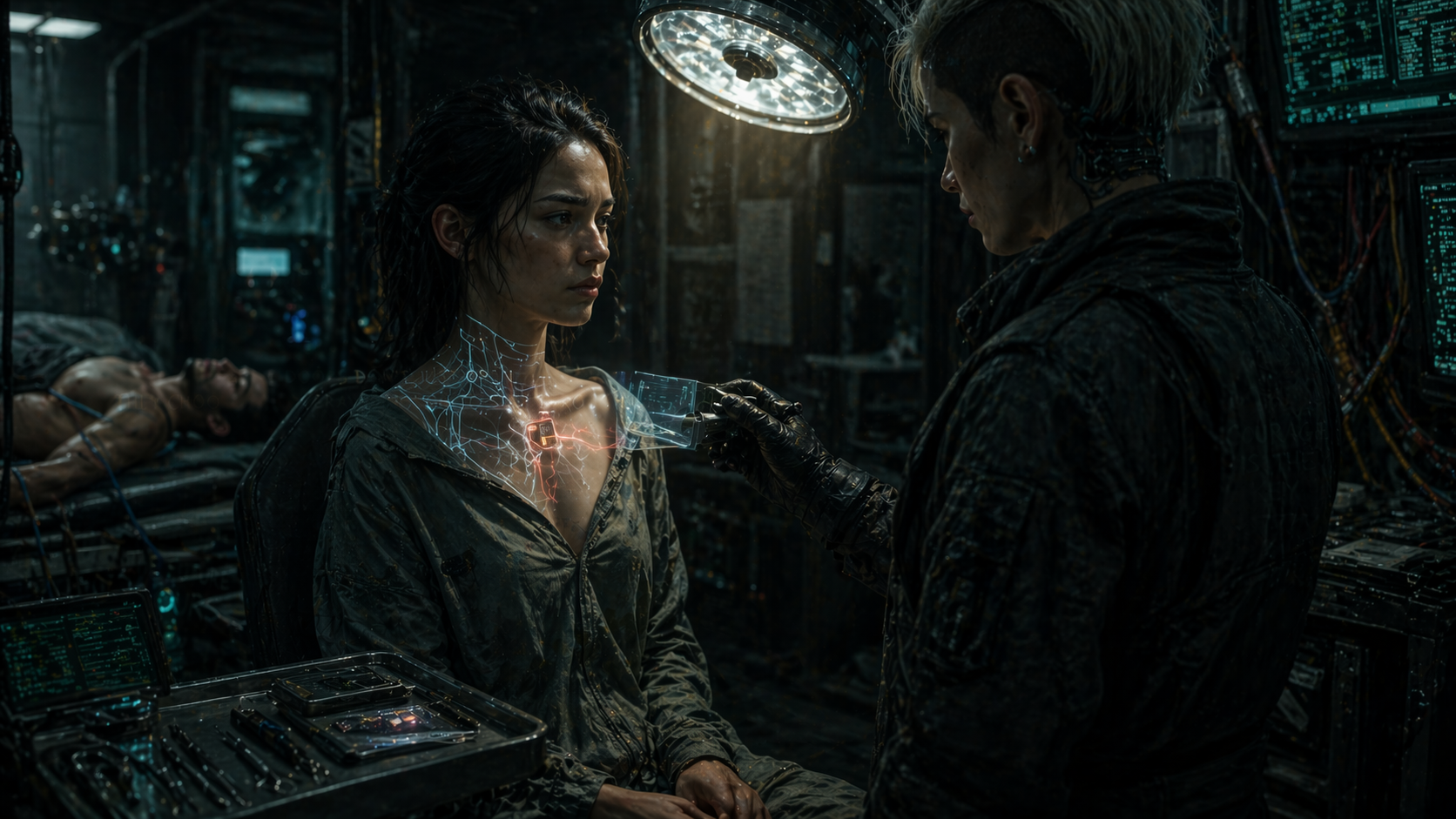
Silver was elbow-deep in a routine calibration — a longshoreman's aging haptic overlay, the kind of cheap mid-stack chrome that starts dropping fingers after five years — when the reinforced door buzzed. Not the front. The side entrance, the one given to clients who don't want to be seen walking into a clinic in the lower stack.
The girl was young. Younger than the message suggested. She wore a cleansuit two sizes too large, hood still up, and held a physical credchip between two fingers like she'd practiced the gesture in a mirror. Her eyes tracked the room in a pattern Silver recognized — corners first, then exits, then the surgeon. Tactical. Not street-learned. Trained.
"You're Silver," she said. Not a question.
She set the credchip on the instrument tray without being asked. The weight of it — the confidence of it — said enough. She listed what she wanted in the flat tone of someone reading from a memorized document: neural combat link, reflex booster L2, subdermal mesh, pain editor. The exact four-piece loadout Militech issues to Tier-2 field operatives. Silver had pulled that chrome out of dead men. Knew what it does to a body over time.
She was fourteen. Maybe.
Silver's hands didn't stop moving. The haptic overlay's third connector was still loose — a faint resistance through the probe tip where there shouldn't be one. The longshoreman breathed steady under sedation. Silver kept working.
"Not what I do." The same level voice that comes out mid-procedure: no room for argument. "Combat suite on a minor. I've deinstalled that exact loadout from three people. None of them were walking when I did it."
The connector reseated. The longshoreman's fingers twitched — good sign.
"Pain editor alone rewires how your nervous system talks to your brain. At your age, that architecture isn't finished yet." A glance up, long enough to read her face, then back down to the arm. "Reflex booster runs hot on a developed body. On yours it'll feel like flying for about eight months. Then you'll start losing fine motor function from the elbows down."
She didn't flinch. Either courage or she already knew.
"So. What are you trying to survive that requires all four pieces? Because whatever it is — there are cheaper ways to still be alive at twenty."
The recycled air hummed. She hadn't moved from the instrument tray.
Silver stepped back, stripped one glove, and gave her full attention. She'd been waiting for it. Didn't rush to fill the silence — another trained response.
Then she talked.
"I have to get out of the district by morning. There are people looking for me. The chrome buys me options if they find me before I'm gone."
Clean. Rehearsed. But her face was doing something her words weren't.
What Silver found was exhaustion. Deep, real, the kind that pools behind a teenager's eyes when they've been running alone for too long. The trained stillness, the practiced delivery — suddenly it all read as fragility performing competence. A kid who was scared and trying very hard not to show it.
Silver's clinical mind filed the read with confidence: she's alone, untethered, no one coming for her. The chrome was a security blanket. She didn't actually know how to use it. She just wanted to feel less exposed.
Something softened slightly.
"District border by morning. That's four hours."
She nodded once. Still watching.
Silver gestured at the second bay curtain without looking up from the instrument tray cleanup. "Sit. I'm not agreeing to anything, but I'm not sending you out that door without knowing what I'm working with."
She hesitated — just a half-second — then moved to the bay and sat on the edge of the cot. The cleansuit crinkled. She kept her hands visible, which told Silver something.
The scanner ran slow across her collarbone, down her sternum. Pulse, pressure, existing chrome signature.
"Other side of the district border. What's there?"
"Transit hub." A beat. "Long-haul freight. There's a manifest slot I can disappear into if I reach it before the 0600 booking window closes."
Specific. She'd thought about this. Planned this.
"And past the transit hub?"
Her jaw tightened. The first real crack in the composure.
"Somewhere they can't send someone after me."
They. Not he. Not she. Institutional. The word landed with a specific weight Silver recognized from chrome serial numbers and surgical scars that don't match any licensed procedure log.
The scanner finished its pass.
It didn't lie and it didn't editorialize. It just showed what was there.
Existing chrome. Not the loadout she'd asked for — something older. A neural suppression collar, deactivated but still seated at the base of her skull, components that would need a full suite to remove cleanly. Military spec. The kind used for asset control. She didn't come here for an upgrade.
She came here to have it taken out.
The combat suite request was a distraction, or a test, or both. The credchip on the tray was payment for the real job she couldn't bring herself to ask for directly.
Silver looked up from the scanner. Her eyes were already there. She knew what had been found.
The silence between them was very specific.
"That's not a combat rig." The same register used when telling someone their chrome is past service life. Clinical. Honest. "That's a leash. You want it out."
Her breath changed. Just slightly — a controlled exhale that came a half-second too late. The trained stillness cracked at the edges and something raw showed through before she pulled it back.
She didn't confirm it. She didn't have to.
The scanner data resolved cleanly in Silver's optical overlay. The collar was Militech manufacture — third-generation asset retention hardware. Rated for long-term deployment. A passive ping function, low-power, cycling every four hours. The last transmission was forty-seven minutes ago. The next one fired in three hours and thirteen minutes.
Removal was possible. The collar's leads ran shallow — whoever installed it was in a hurry, or didn't expect it to need to last. A clean extraction would take forty minutes, maybe less. But the moment the main lead was severed, it would broadcast a termination signal. A dead-man's switch. Whoever held the receiver would know the collar was gone the instant it was cut.
Three hours, thirteen minutes. And someone already knew what block she was on.
Silver set the scanner down on the tray, carefully, the way instruments get set down when hands need to be free and the voice needs to do real work.
"Militech asset retention collar. Third generation. It pings every four hours. Last transmission forty-seven minutes ago. Which means whoever holds the receiver already knows you're in this district."
She was very still.
"There's a dead-man switch in the primary lead. The moment I cut it, it broadcasts a termination signal. Not a location — a status. Gone. They'll know the collar is out the second I sever it. Doesn't matter which side of the district border you're on when that happens."
The longshoreman breathed steadily behind them. The recycled air hummed.
"Three hours and change before the next scheduled ping. That's the window. I can take it out. The work itself isn't the problem. But you need to tell me who holds that receiver. Because when the signal fires, they're coming here, or they're coming for you — and right now I don't know which."
Silver stopped talking.
The surgical bay hummed. Somewhere in the alley outside, water dripped from a recycler overflow. The trained stillness held for about four seconds. Then something moved through her face — not panic, not tears — something quieter and worse. A kind of recognition. Like Silver had named something she already knew but had been successfully not-thinking-about for however many hours she'd been running.
Her jaw tightened. A breath, carefully controlled. Her eyes dropped to the credchip on the tray for just a moment — did I bring enough, is this enough — and then came back up.
The composure reassembled. Slower than it came apart.
She swallowed once.
Then she said, very quietly: "His name is Miko."
Just the name. Like it cost something.
The name sat in the air between them.
Silver had heard it before — somewhere at the edge of the supply network, a ghost of a reference, nothing that placed cleanly. The way she said it told more than the name itself. Not my handler. Not my owner. Just the name, bare, the way people name things they're afraid of.
"Handler, owner, or something else entirely?"
She answered. Told Silver he was her handler. Militech contract, deep cover division, the kind that doesn't exist on paper. She was an asset — recruited young, she said, like that explained everything and nothing simultaneously.
But the part she didn't say was louder.
When she named him handler, her shoulders dropped a fraction — the word practiced, clinical, the approved vocabulary. But her hands, resting on her knees, curled slightly. And her eyes did something specific: they went flat in a way that isn't trained calm. It's shutdown. The thing you see in patients who've learned to survive by not-feeling the thing that's happening to them.
Miko isn't just her handler. The collar, the combat suite she asked for — she doesn't want to run from him. She wants to be able to fight him. Whatever he is to her, it's personal in a way that a contract relationship isn't.
She's not just running. She's done.
Silver filed that carefully. It mattered, and not only for the surgery.
"I can take the collar out. I can't put the combat gear in. And you need to give me some time to figure out how to handle that signal."
She didn't answer right away.
She looked at Silver — really looked, the way trained people look when they're evaluating whether to trust something or burn it — and what she found wasn't enough. Silver was a stranger in a clinic she'd found through a chain of contacts she didn't fully trust. Telling her to wait and let me think while refusing the one thing she'd asked for.
She stood up.
"I don't have time for you to figure it out." Her voice flat again, the practiced affect back in place, but she picked up the credchip from the tray. Not pocketing it — holding it. Still negotiating, maybe. Or deciding.
"If you can't tell me right now how you handle the signal, I find someone else."
Three hours, eleven minutes.
She wasn't gone yet. But she was standing, and the door was behind her, and whatever window existed for easy trust had just closed.
"Sit down."
She stopped.
"The collar pings every four hours. Low-power transmission, passive cycle." Silver was already pulling up the collar's spec data on the overlay, cross-referencing against the rig's Skinweave module. "I spoof the signal. Clone the collar's transmission signature before I cut the lead. When the dead-man fires, Miko's receiver doesn't get a termination status — it gets another ping. Normal cycle. Asset secure."
A look up.
"He thinks the collar is still active. Still on you. That buys you four hours before the next scheduled ping drops wrong, and by then you're across the border and I'm just a clinic he can't prove you were ever in."
Her hand still on the credchip.
"It's not a permanent solution. Four hours. Maybe less if his receiver has secondary verification. But it's the difference between him knowing the instant I cut the lead, and him not knowing until you're already gone."
She sat down. It wasn't graceful — she just folded, like the decision took the last of something she'd been running on.
"Ninety minutes," she repeated. Testing it. Like she was checking whether the number was real.
Then Silver's second question landed — do you have somewhere to go after? — and the composure cracked differently this time. Not shutdown — something rawer. She looked at the middle distance and actually didn't know the answer. No practiced deflection. Just a girl doing real-time inventory of a life that apparently didn't include anywhere safe to go.
"I have a contact," she said finally. "Maybe. I don't know if they'll—" She stopped. Started over. "I don't know if they're still clean."
She looked at the credchip in her hand.
"Does it matter? If I'm weak it doesn't matter. I'll figure it out."
The words were brave in the specific way that means terrified.
"I can only start when I know you won't collapse in front of my clinic. I can ask someone I trust. He won't ask questions. You can take the rear exit after, get to his place, recover there."
Her gaze went tactical again, reading for the angle. Then something settled in her face. Not quite trust. Provisional acceptance. The best you're going to get from someone who's been wearing a leash.
She nodded. Once.
"Bishop," she said, like she was memorizing it.
The curtain moved before Silver reached it.
Bishop stepped out. He looked at Silver, then past at the girl, then back. His expression was the careful neutral of someone who had already made a decision and was choosing how to deliver it.
"No."
Just that. Quiet, no heat in it.
"Silver." He said the name like it was a full sentence. "I trust you. I don't know her. And whoever put that hardware in her neck — I run mid-stack routes. I've got two regulars who know my door. I bring a Militech problem home, those routes are gone."
He wasn't angry. That was almost worse. He'd made a clean calculation and the math didn't come out in the girl's favor.
"Bishop, look at her. She's being tracked. Someone owns her. We gotta do something about that."
Bishop looked.
Really looked. Took in the over-controlled posture, the exhausted eyes, the credchip still in her hand. The collar he couldn't see but knew was there now.
A long moment.
His jaw worked slightly. His gaze dropped to his left hand — the one with the nerve damage, the one a cheap ripperdoc left half-dead before he found Silver. He knew what it meant when someone else's hands are on your body without permission. He knew what it costs when the person doing the work doesn't care whether you walk out whole.
He looked back.
"Ninety minutes." Not a question. Not agreement yet — a number he was testing against something internal.
"She takes the rear exit. She's clean before she walks in my door." Another beat. "And Silver — if this comes back on me, we talk about it. You don't just make that go away."
"You have my word."
No qualifiers. No I'll try or best I can. Just the flat, clean statement, the same register Silver uses when telling someone exactly what their chrome is costing them.
Bishop held the gaze for three seconds. Reading it the way he always does — not the words, the weight behind them.
Then he nodded. Once.
"Alright." He looked past Silver at the girl. Something in his face that wasn't quite softness but was adjacent to it. "Rear exit opens to the maintenance corridor. Third left, service elevator. I'll leave the door on latch."
He picked up his jacket from the chair by the curtain.
"Wake me when you're done." He said it to Silver, not her. Then he was moving toward the front, unhurried, already calculating how ninety minutes fits into the rest of his night.
The girl was watching the space where Bishop had been standing. The credchip still in her hand but her grip had changed — looser now. Something released that she'd been holding since she walked in.
She looked at Silver.
"Okay," she said. Quiet. Real.
The clock was running.
The longshoreman came up slow — sedation fog, the usual confusion, the moment where they don't know where they are and their hand goes to their side before they remember the blade is gone.
"You're done. Neural stabilizer held. Don't stress the interface for seventy-two hours."
He squinted. "What do I owe—"
"Already paid." Silver handed him his jacket. "Front door. Don't come back before the follow-up."
He was gone in four minutes. Silver locked the front, dropped the service light to red — closed — and pulled the rear curtain across.
Then sat down at the workbench and jacked into the collar's output frequency.
The Skinweave module was built for ID forgery — biometric cloning, credchip spoofing. A transmission signature is simpler than a retinal profile in theory. In practice, Militech's asset retention hardware uses a rolling authentication key that cycles with each ping. The last broadcast could be cloned. Whether the spoof would hold when the receiver expected the next key in sequence was the question.
Silver chased the pattern. Built a framework around it. The spoof took shape in the overlay and it looked right, it felt right — but when the silent test transmission ran, the receiver handshake failed. The collar's architecture was one generation ahead of the working tools. The framework cloned the format of the key but not the logic that generated the next one in sequence. Miko's receiver would see the ping, read the authentication, and flag it as malformed.
Third tray, bottom compartment — the salvage nobody throws away because in this work, yesterday's junk is tonight's solution. Partial neural interfaces, a cracked optical module, decommissioned subdermal ID chips. And underneath those — a Militech asset tag. Gen-2, not Gen-3, pulled from a patient two years back. Cracked housing, but the authentication core still intact.
The Gen-2 key structure mapped against the Gen-3 collar's output and the framework clicked. The gap between generations wasn't as wide as feared. Same foundational logic, just an additional verification layer on top. The test transmission ran again.
The handshake completed. The spoof held.
Fifteen minutes lost to verification Silver's own competence had made necessary — walking back the transmission log line by line, the way a shorted lead gets traced in a neural stack. The log resolved clean. No secondary transmitter, no ghost process, no hidden flag.
"It's good. We're ready."
Silver pulled on gloves and angled the surgical lamp toward the bay.
"Get up on the table."
"The spoof is running. Every four hours, Miko's receiver gets a ping. Collar active, asset secure. He won't know until the sequence breaks — and by then you're gone."
The syringe went down. A direct look.
"I'm going to make an incision at the base of your neck, just below the hairline. The collar's anchor points are subcutaneous — four leads, minimal depth. I'll disconnect the dead-man trigger first, then the power cell, then pull the housing. You won't feel anything. You'll wake up sore. The incision closes clean — two, maybe three weeks and there's no visible scarring."
She was listening. Completely still.
"Any questions before I put you under?"
She thought about it. Then: "Will it hurt. After."
"Yes." Because she deserved the straight answer. "Manageable. Bishop will have what you need."
Something in her face settled. Like honesty was the specific thing she needed and didn't know how to ask for.
Silver swabbed the IV site. She watched the needle go in without flinching.
Thirty seconds later her eyes closed.
The scanner sweep took ninety seconds. Four anchor points, exactly where the spec suggested. Dead-man trigger sitting on the left posterior lead, hardwired to the power cell. A clean picture, no surprises.
Good. Surprises kill patients.
The incision first. Steady hands, clean line. The collar's housing sat shallower than expected, maybe six millimeters of subcutaneous depth. Whoever installed this wasn't worried about comfort. They were worried about removal.
The dead-man trigger was first. This was the part where hands couldn't shake.
The trigger lead separated clean.
No signal fired. No cascade. The dead-man switch went dark in the overlay and stayed dark — a flatline where a countdown used to be.
An exhale through the nose. Don't stop moving.
The power cell disconnected next, then the three remaining anchor leads, methodical as breathing. The housing lifted free in Silver's palm — small, surprisingly light, the kind of thing that shouldn't have the weight it carries. It went into the tray without ceremony.
The incision closed in four sutures.
Gloves stripped, dropped. Vitals checked. Steady. She'd surface in twenty minutes, maybe thirty.
Silver looked at the collar sitting in the tray.
Done.