Epic Sci-Fi · Chapter 1
The Tithe Was Short
Sythe, Seeker
Three Resonants short of the annual accounting. A station elder with thirty years of clean yield reports. A girl pressing her face against the inner seal. The Synod sent a Seeker to make the numbers match. The forms knew exactly the right size for what was about to happen.
The children sat in the processing bay like ore waiting to be graded.
Sythe had seen it a hundred times — the rows of them on the holding benches, the particular stillness of children who had been told not to move and had decided that obedience was the safest performance. Their parents stood at the perimeter in the careful posture of people who had learned that movement drew attention. One small girl, nine years old at most, had pressed her face against the inner seal's plasteel, fogging it with her breath, watching the docking corridor with the focused intensity of someone looking for a reason not to be afraid.
Her mother was watching her from across the bay with her arms rigid at her sides.
Sythe walked past without breaking stride.
"Three absent from the annual accounting," Maelich said, falling into step. He had the look of a man who'd stopped sleeping well, the grey robes catching grit from the ventilation ducts. "The settlement elder has been here thirty years. Built the yield reports that paid for this station's second hab-ring." A pause — precise, chosen. "He'll be polite. That's the part that makes it harder."
The Assessor-General arrived in four days. The tithe was short. In the Synod's vocabulary there was a term for what happened when numbers didn't resolve themselves: _supplementary selection._ A clean phrase. Administrative. The kind of language that kept the machinery oiled and the hands of the people who operated it from feeling wet.
"I want him before he's had time to rehearse," Sythe said.
Maelich nodded and did not say _I hope you know what you're doing._ He was one of the careful ones. He said it with his silence instead.
The elder's office was exactly what the station was: functional to the point of stubbornness. Gavren sat with both hands flat on the bolted desk, and he was bigger than Sythe had expected — broad through the shoulders, grey at the temples, with the kind of face that had been compressed by pressure differentials and hard news and come through the other side still intact. On the wall behind him hung a commendation plaque, gold lettering, Synod seal: _thirty years of faithful service._
He wasn't looking at it.
"Two died in the Caerun shaft collapse," he said. "Eight weeks ago. I have the incident reports."
He did not mention the third.
Sythe laid out the mechanics of it plainly. The quota was the quota. Supplementary selection would proceed. He would provide documentation of the collapse or it became withholding, and withholding was a criminal matter, and he should consider carefully what distinction he wished to make between a mistake and an orchestrated operation. The third name.
He should give Sythe the third name now.
The silence stretched. Sythe watched Gavren's hands press fractionally harder into the desk. Not grief. Not helplessness. The specific tension of a man managing what he was permitted to show. _He knows where she is._ The read landed with certainty. _He's decided you won't._
The commendation plaque said _thirty years of faithful service to the hegemony and its sacred works._ A man who had watched children leave this platform for three decades, seen banners folded in exchange, built the infrastructure those departures paid for.
He wasn't hiding the girl out of defiance.
He was hiding her the way you'd hide something irreplaceable.
"She was frightened," he said.
_Was._ Present tense would have been: _is._
Something left his face then. Not fear — something quieter. He looked at Sythe the way a man looks at a door he thought might open that didn't.
"Sublevel three," he said. "Eastern ore-sorting block."
Maelich, by the door, went very still.
Twenty meters. The noise of the sorting floor filled everything — the grind of conveyors, ore moving through the gates, voices calling measurements. Her station faced away from the entrance and the sound swallowed footsteps. She hadn't turned.
The workers had made a subtle geometry around her. Not gathering. Not retreating. Just the unconscious arrangement of people who knew something was about to happen and had decided to bear witness without participating.
_She sorts ore on sublevel three and she's afraid of the dark._ The elder's voice.
Fifteen meters.
She ran.
Sythe cut the angle, armor weight finding its rhythm, dropping left through the conveyor row and gaining ground she didn't know she'd lost. Through a junction. Hand on her collar — controlled, deliberate — and momentum carried them both into the corridor wall. She twisted. Sharp. Desperate. Elbows that found nothing.
"Stop."
She went still. Breathing hard. Her eyes were fixed on the maintenance corridor ahead — the route she hadn't taken. Looking toward the dark at the next junction.
_Afraid of the dark,_ Gavren had said.
She was running toward it.
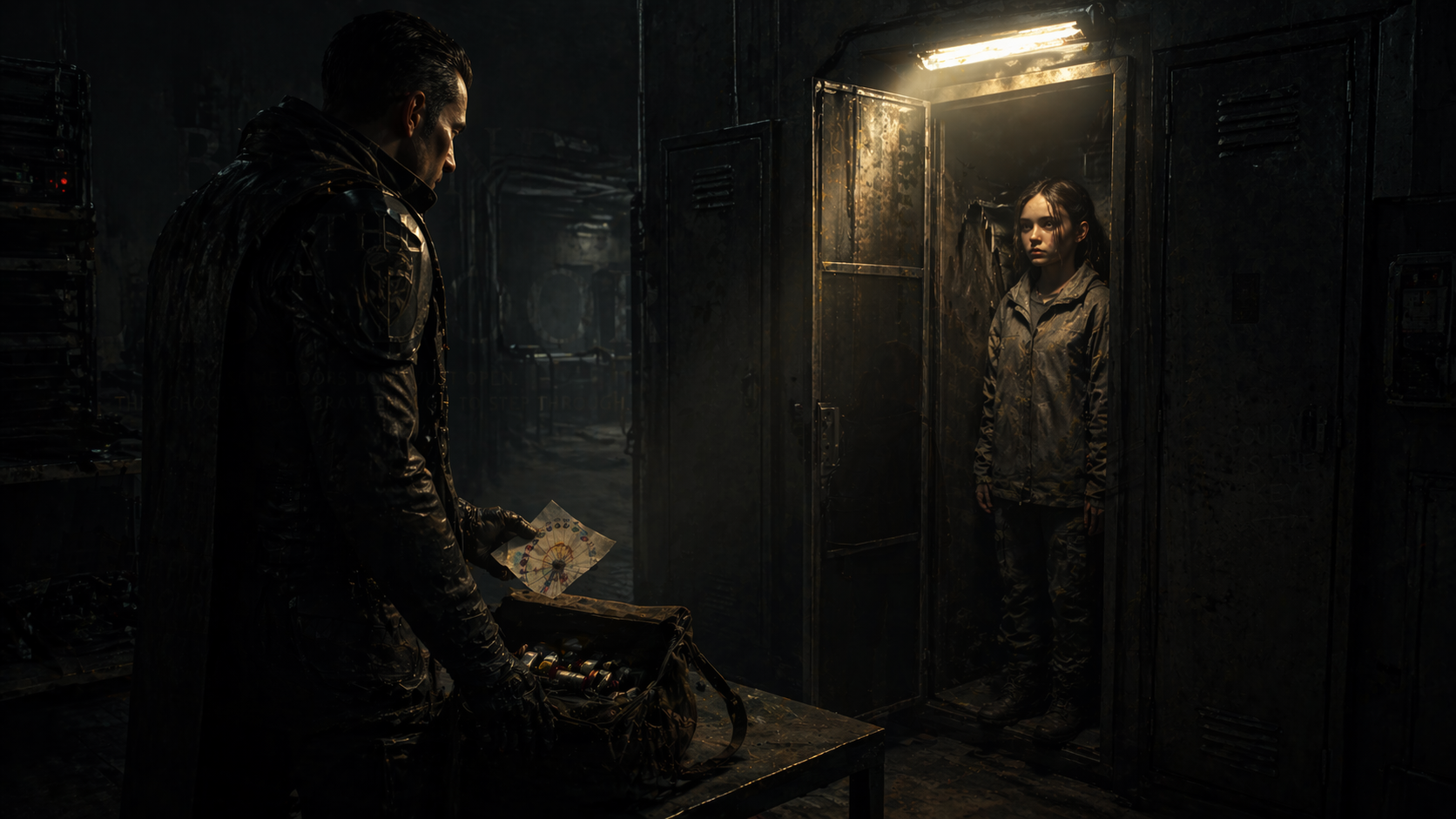
The equipment locker smelled of mineral dust. Sythe killed the light before sealing the door. No sound from inside — no crying, no pounding. Just silence, which was somehow worse than either.
The maintenance tunnel ran deeper than the station's official schematics. That alone was information. Twenty meters in, the first marker: three horizontal scratches at knee height, deliberate spacing. Further ahead, the air changed — warmer, with something beneath the mineral smell.
Habitation. Someone had been living here.
A bedroll wedged between conduit housings. Ration packs. Three suppressant vials in dark glass, unmarked. A forged identity document with the wrong registration prefix on the Synod certification seal — professionally done, the kind that required institutional knowledge to produce.
And pinned to the wall with a length of wire: a child's drawing.
Sythe documented it. Three passes — wide, medium, close on the vials. The drawing last. Then took it down anyway.
The note read: _Stay below three until the bell. I'll come when it's safe. Don't let them find the vials._
Educated hand. Not a station worker.
Back in the equipment locker, Mira Solenne stood exactly where Sythe had left her. She hadn't sat. In the darkness she had remained perfectly still, and when the corridor light fell across her face she didn't flinch — she had been expecting this. Her eyes went to the satchel. Something in her expression shifted almost imperceptibly and then closed.
Fourteen years old. Forged documents since she was seven. A handler with Synod knowledge who had taught her exactly what to fear and exactly how to stand when it arrived.
She had been prepared for this moment for years.
Maelich ran the attunement rod slow across her sternum. The filament's hum was the only sound in the locker. It steadied — not the full harmonic, not the deep resonance that made your back teeth ache. A flutter. There and gone.
_Mid-tier minimum,_ Maelich said. _Possibly higher._
Mira looked at a point past Sythe's shoulder and said nothing. The suppressants were doing their work. Mostly. But _mostly_ wasn't clean, and she knew what the flutter meant, and she knew they both knew, and she chose silence anyway. Seven years of choosing it. Whatever the handler had built in her was more durable than the evidence on the table, more durable than the certainty of what came next.
_I don't know who wrote that note._
The handler was still on this station. Still waiting for a bell that wouldn't ring.
Hab-block four. Residential ring. Unit seven.
_The girl doesn't know what she is. Essara never told her._
Gavren's voice, from the detention cell, setting something down that had been very heavy.
Sythe knocked.
The woman who opened the door was mid-forties. Dark circles, the kind of stillness that comes from fourteen years of practiced calm. She took in the uniform, the blade, the retainers, and her face did something she immediately controlled.
She knew why Sythe was here.
Behind her — visible for just a moment before Essara shifted her body to block the view — a girl. Fourteen, slight, dark-haired, sitting at a table with a half-eaten meal in front of her. Looking up with the uncomplicated curiosity of someone who didn't yet understand what this presence meant. Tenne Valenne. Unregistered. Unaware.
Essara Valenne filled the doorway and said nothing. Every muscle in her body a decision she hadn't made yet.
Sythe told her to stay calm. Told her Tenne would come for an assessment. Told her she would hear from the Synod about the matter of a hidden Resonant.
"She's my daughter." Quiet. Precise. The voice of a woman who had said this sentence ten thousand times in private and always known it wouldn't be enough.
Behind her, Tenne had gone still. The uncomplicated curiosity was gone. She was reading the room the way children read rooms when adults stopped pretending — watching her mother's back, watching Sythe's face, trying to find the vocabulary for what was happening.
Tenne stood up from the table. Slowly.
"Mum," she said.
The question landed like something dropped from a great height.
"What's an assessment?"
Essara turned. Looked at her daughter for one long second — fourteen years of forged records and suppressants and quiet terror compressed into the expression on her face, into the space between one breath and the next. Then she turned back.
She stepped aside.
Not surrender. Something heavier than surrender. The recognition that the Hegemony had more weight than one mother standing in a doorway, and that she had always known this moment was coming, and that knowing had not helped at all.
The report wrote itself. Sythe had done this before — the forms were familiar, the language institutional, the boxes exactly the right size for what had happened here.
_Missing tithe. Unauthorized assessment. Handler network. Detained suspects. Recovered Resonant candidate._
Clean. Procedurally sound.
Maelich found Sythe an hour later, while the report was still being written.
"Positive attunement markers," he said. Quietly. "Mid-tier, possibly higher. She'll need full evaluation at the processing facility." He set a cup of something warm beside the report. "She cried when I told her she couldn't see her mother yet."
He left without another word.
Outside, somewhere in the station's recycled air and mineral dark, Essara Valenne was waiting to hear what happened next.
The report sat complete on the desk. Every box filled. The Assessor-General would find nothing to fault.
Sythe did not look at the child's drawing in the satchel. The one pinned to the wall with a length of wire, in a habitation that wasn't on any official schematic, in the dark where a girl had made herself a home so small and so hidden that the empire had taken seven years to find it.
The transit bell struck somewhere above. The tithe was no longer short.